publications
Peer-reviewed publications, most recent first.
2026
- Estimating Interventional Outcomes over Time with Causal Normalizing FlowYoonseok Yeom, Jonghwan Kim, Taehui Yun, Juhyun Lyu, and 6 more authorsIn Forty-Second Annual Conference on Uncertainty in Artificial Intelligence. Equal contribution by Yoonseok Yeom and Jonghwan Kim , 2026
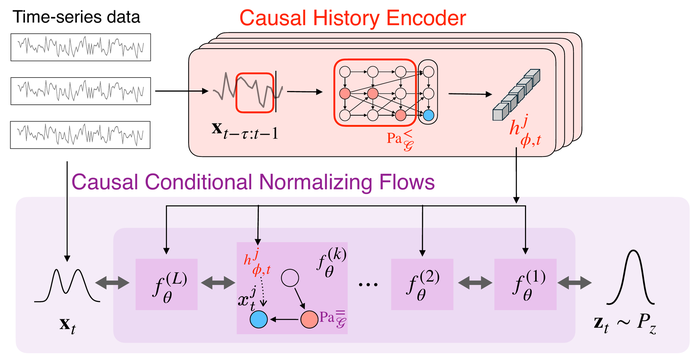
Estimating outcome distributions under time-varying treatments is an essential task for personalized decision-making, particularly in domains such as healthcare. Most prior work in this area focuses on point predictions, which fail to capture the inherent variability in outcomes. Recent efforts in causal inference have begun integrating generative models to address this limitation by estimating interventional distributions. However, existing approaches—including causal normalizing flows—are generally restricted to static settings and are not well suited to sequential, time-dependent data. In this work, we propose a novel framework that extends causal normalizing flows to time-series, enabling simulation-based interventional density estimation over time. Our method learns representations of treatment and covariate history that capture temporal dependencies. Conditioned on these representations and guided by a causal graph, our flow-based model generates interventional samples, allowing for the simulation of outcome trajectories under alternative treatment strategies. We evaluate our approach on both linear and non-linear synthetic time-series as well as on a simulated tumor growth dataset, demonstrating that it achieves performance competitive with state-of-the-art baselines, while accommodating a broader spectrum of causal queries.
@inproceedings{yeom2026estimating, title = {Estimating Interventional Outcomes over Time with Causal Normalizing Flow}, author = {Yeom, Yoonseok and Kim, Jonghwan and Yun, Taehui and Lyu, Juhyun and Kim, Jung-Hee and Lee, Sangmin and Yang, Jinseok and Jung, Hyemin and Lim, Woohyung and Lee, Sanghack}, booktitle = {Forty-Second Annual Conference on Uncertainty in Artificial Intelligence}, year = {2026}, url = {https://proceedings.mlr.press/v337/yeom26a.html}, } - Breaking Bad: Component-Wise Parent Deletion for Score-Based Causal DiscoveryMin Woo Park, Taehui Yun, YoungIn Jang, Yoonseok Yeom, and 7 more authorsIn Forty-Second Annual Conference on Uncertainty in Artificial Intelligence, 2026
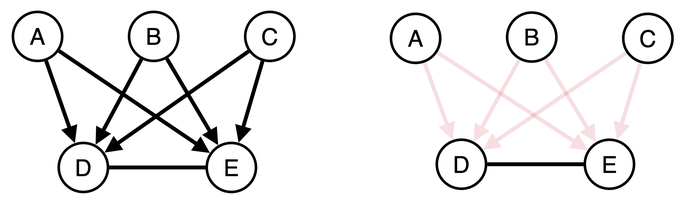
Directed acyclic graphs (DAGs) are widely used to represent complex causal relationships in real-world systems. The goal of causal discovery is to learn the underlying DAG from data generated by these systems. While Greedy Equivalence Search (GES) is a well-established score-based algorithm for causal discovery, the GES family often suffers from scalability and sample complexity issues due to its large search space and susceptibility to local optima. In this paper, we introduce parent deletion, a novel, simple, yet powerful operator for score-based causal discovery. This operator is theoretically sound and effectively alleviates these limitations. Moreover, its simplicity enables seamless compatibility with existing score-based methods, and extensive experiments demonstrate consistent improvements across a wide range of settings.
@inproceedings{park2026breaking,
  title = {Breaking Bad: Component-Wise Parent Deletion for Score-Based Causal Discovery},
  author = {Park, Min Woo and Yun, Taehui and Jang, YoungIn and Yeom, Yoonseok and Kim, Jonghwan and Kang, Jiyeon and Kim, Songseong and Jung, Hyemin and Lee, Sangmin and Jang, Jongseong and Lee, Sanghack},
  booktitle = {Forty-Second Annual Conference on Uncertainty in Artificial Intelligence},
  year = {2026},
  url = {https://proceedings.mlr.press/v337/park26b.html},
}
2025
- On Incorporating Prior Knowledge Extracted From Large Language Models Into Causal DiscoveryChanhui Lee, Juhyeon Kim, Yongjun Jeong, Yoonseok Yeom, and 9 more authorsIEEE Access, 2025
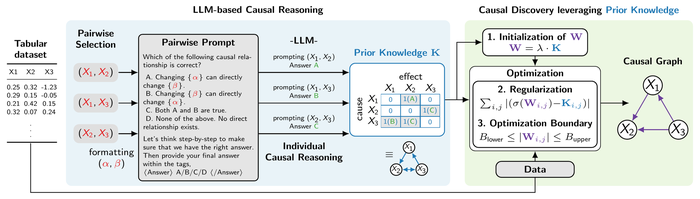
Large Language Models (LLMs) can reason about causality by leveraging vast pre-trained knowledge and text descriptions of datasets, demonstrating their effectiveness even when data is scarce. However, there are crucial limitations in current LLM-based causal reasoning methods: i) LLM prompting is inherently inefficient for utilizing large tabular datasets when accounting for context length consumption, and ii) the methods are not adept at comprehending the whole interconnected causal structures. On the other hand, data-driven causal discovery can discover the causal structure as a whole, although it works well only when the number of data observations is sufficiently large. To overcome the limitations of each approach, we propose a new framework that integrates LLM-based causal reasoning into data-driven causal discovery, resulting in improved and robust performance. Furthermore, our framework extends to time-series data and exhibits superior performance.
@article{11220238,
  title = {On Incorporating Prior Knowledge Extracted From Large Language Models Into Causal Discovery},
  author = {Lee, Chanhui and Kim, Juhyeon and Jeong, Yongjun and Yeom, Yoonseok and Lyu, Juhyun and Kim, Junghee and Lee, Sangmin and Han, Sangjun and Choe, Hyeokjun and Park, Soyeon and Lim, Woohyung and Lim, Sungbin and Lee, Sanghack},
  journal = {IEEE Access},
  year = {2025},
  volume = {13},
  number = {},
  pages = {194691--194713},
  keywords = {Cognition;Large language models;Prompt engineering;Training;Time series analysis;Sea ice;Optimization;Measurement;Hands;Electronic mail;Causal discovery;time series causal discovery;LLM;hallucination},
  doi = {10.1109/ACCESS.2025.3626040},
}